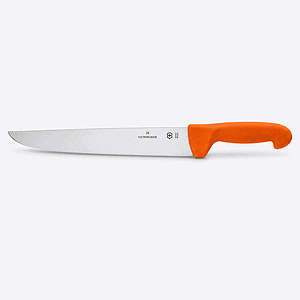
ICEL and Victorinox knives, including the Swibo line, for butcher shops, gyro shops and the food industry, with straight or curved blades from 13 to 40 cm. Here you'll also find the Salvador grinder plate and knife for meat grinders.
Showing 3 of 3 products
Showing 3 of 3 products
Knife guide
Start with the job the knife will do: boning, slicing, gyro or cheese. Then look at blade shape, length and handle color, especially if you handle both raw meat and ready-to-eat food in the same kitchen.
A curved blade follows bone and joints more easily when boning, while a straight blade gives long, even cuts for slices and portions. For boning, a stiff knife suits beef and pork, and a flexible one suits chicken and fish. ICEL knives with black handles come straight in 24 and 26 cm and curved in 13 and 15 cm. From Victorinox we have Swibo straight knives in 29, 31 and 36 cm and a Victorinox curved knife in 25 cm.
For doner and gyro we have the 40 cm ICEL knife. For cheese and kashkaval we have a 36 cm ICEL knife with two handles, which you press down with both hands.
ICEL is a Portuguese knife maker, and the ICEL knives we carry are made for heavy use in butcher shops and the food industry. Swibo is Victorinox's line for butchers and fishmongers. According to Victorinox, the polyamide handle is sealed to the blade with no gaps where dirt can collect, and the blade has a hardness of 55 to 58 HRC.
Handle colors help make sure the knife used for raw meat isn't used for ready-to-eat food. There's no single international scheme, so choose one, write it into your HACCP plan and train your staff to follow it. The ICEL knives we carry come with black or blue handles.
A honing steel realigns the edge without removing metal, while sharpening on a stone or machine does remove it. In a butcher shop, run the knife over the steel every working day, at the same angle as the edge, alternating sides with each pass. When the steel no longer brings the edge back, the knife needs sharpening.
The meat grinder
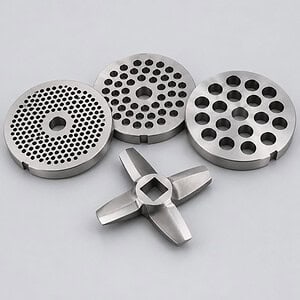
The plate is the disc with holes the meat comes out of, and the knife is the cross that turns right against it. They work as a pair, so they're always sharpened together to keep the surfaces in close contact. When one is worn, check the other too, because the grind depends on how well the two fit together.
There's no fixed interval; go by the condition of the plate and knife. Sharpen or replace them when the meat comes out more crushed than minced, when the machine slows down or jams often, or when the plate has cracks or chipped edges. Damaged parts are also harder to clean.
The plate and knife must match the size of the grinder head, the plate diameter and the center hole. Here you'll find the SALVADOR KKO 32/4,5 plate and the KMMH 32A knife. Before ordering, compare the measurements with the part you have, or give them to us over the phone.
For the binders, netting and bamboo skewers used in meat processing, see meat additives and accessories.
Tell us what meat you work with and which grinder you have, and we'll send you a quote for the knives or parts. Call us at +355 69 202 6314 or write to us via Contact.
Short answers about knives. For anything else, contact us.
For boning, choose a curved blade, which follows the bone more easily. Use a stiff knife for beef and pork and a more flexible one for chicken and fish.
On the honing steel, every working day. The steel realigns the edge without removing metal. Sharpen on a stone or machine when the steel no longer brings the edge back.
When the meat comes out crushed instead of minced, when the machine slows down or jams often, or when the plate has cracks. Always sharpen the plate and knife together so they fit closely.


A trusted name in Albania's food industry since 1993, offering quality, innovation and reliable solutions for steady business growth.